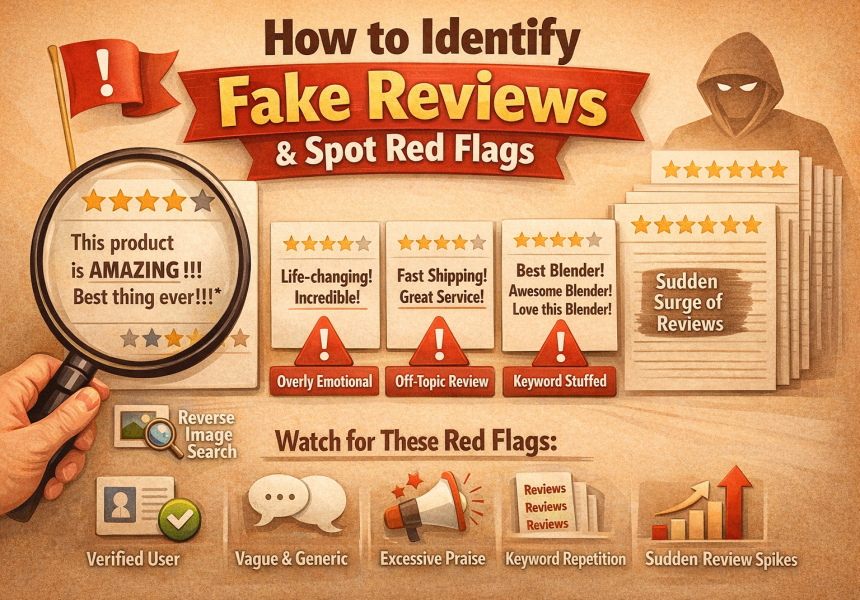
How to Identify Fake Reviews and Spot Red Flags
When shopping online or choosing a service, reviews are often our go-to source of information. They can help us make informed decisions, but unfortunately, not all reviews are trustworthy. Fake reviews, whether positive or negative, are widespread and can be challenging to spot. However, with the right knowledge and strategies, you can identify fake reviews and avoid being misled.
In this guide, we’ll cover how to identify fake reviews, the red flags to watch for, and the tools you can use to verify the authenticity of a review.
How to Spot Fake Reviews Online: Red Flags You Need to KnowKnowing how to spot fake reviews online can save you time, money, and frustration. Fake reviews often use certain tricks to appear credible, but there are key indicators that you can watch for. Here’s a breakdown of fake review red flags:
a) Generic or Vague Language
Fake reviews are often short, vague, and generic. A review that says “This is amazing!” or “Great experience!” without any specific details is likely fake. Real customers tend to provide specific feedback, such as "The leather quality is top-notch" or "I found the checkout process smooth but the delivery could be faster."
Fake Review Red Flag: Generic phrases or vague comments that don’t provide meaningful insight.
b) Overly Emotional or Excessive Praise
Fake reviews often include excessive praise with overly emotional language like “life-changing” or “the best thing ever.” While some users may genuinely feel that way, such language can sometimes be used to manipulate or exaggerate a product's quality.
Fake Review Red Flag: Over-the-top praise without meaningful context or specifics.
c) A Sudden Surge of Similar Reviews
Fake reviews can sometimes flood the review section, especially when a product is new or launched in a campaign. If you see an unusual spike in positive reviews within a short period, especially with repetitive language, it could be a sign of fake feedback being posted.
Fake Review Red Flag: A flood of similar reviews posted in a short time span.
d) Irrelevant or Off-Topic Reviews
Fake reviews sometimes focus on irrelevant aspects, like shipping or customer service, when the review should focus on the product. If a review is praising fast shipping on a product review, it’s a red flag that the reviewer may not have used the product.
Fake Review Red Flag: Reviews that mention shipping, packaging, or other irrelevant details instead of the product or service itself.
e) Excessive Use of Keywords
Some fake reviews are stuffed with keywords in an attempt to improve search rankings. For instance, a review might use the same brand name or product name multiple times unnaturally. Authentic reviews focus more on the user’s experience rather than being overly promotional.
Fake Review Red Flag: Overuse of keywords or phrases that feel unnatural.
How to Spot Fake Reviews: Quick Tips to Avoid Falling for Them
Here are some actionable tips on how to identify fake reviews effectively:
a) Look for Consistency
Consistency is essential when reading multiple reviews. When spotting fake reviews, pay attention to the overall tone and sentiment. If a review is way more positive or negative than the rest, it could be fake.
Tip: Look for consistency in user feedback across multiple platforms.
b) Look for Detailed Reviews
Real reviews are usually detailed. They mention specific features of the product or service and offer clear feedback about both pros and cons. Fake reviews are often vague, saying little more than “it’s great” or “don’t buy this.”
Tip: Reviews that provide specifics, like product features or details about the user’s experience, are often genuine.
c) Be Cautious of Highly Rated New Products
Be cautious when a new product has a sudden surge of high ratings right after launch. This could be an attempt to manipulate initial impressions. If you see a sudden influx of glowing reviews, consider whether they are legitimate.
Tip: Read with a critical eye, especially for new products or services.
Tools and Resources to Verify the Credibility of a Review
Several tools and methods can help you verify whether a review is authentic or fake. Here’s what you can use to confirm a review’s credibility:
a) Reverse Image Search
To check if the photos in the review are stolen or unrelated, you can use tools like Google Reverse Image Search. This allows you to find where else the images have been posted across the web, which could indicate whether they belong to the reviewer or are taken from another source.
How to use it: Right-click the image in the review and select "Copy Image Address." Paste it into Google Reverse Image Search to find where else it has been posted.
b) Verified User Tags
Many websites, like Amazon or Yelp, mark reviews from verified buyers or users. This can help you spot fake reviews as verified users are usually more trustworthy.
Tip: Verified user tags add credibility to the review, ensuring the feedback comes from actual customers.
c) Third-Party Review Platforms
Platforms like Trustpilot and Consumer Reports offer aggregated reviews from verified users. These sites often have better moderation systems in place to filter out fake reviews.
Tip: Check out independent review platforms for a broader perspective.
d) Review Analytics Tools
Tools like Fakespot or ReviewMeta analyze reviews on platforms like Amazon to identify suspicious patterns. These tools examine the language, frequency, and quality of reviews to determine if they are likely fake.
How to use it: Copy the product URL and paste it into these tools for an automatic analysis of the review quality.
Real Examples of Fake Reviews
Let’s dive into some real-world examples of fake review red flags to help you identify them faster:
Example 1: The Overly Emotional Review
A review reads: “This product is a miracle! It changed my life completely, I can't live without it!” This review lacks specifics and uses exaggerated emotional language, making it a strong candidate for being fake.Example 2: The Generic Praise Review
“I love this product. It works great.” This review doesn’t provide any details or specific feedback. Real reviews are typically more thorough, offering useful insights on how the product works.Example 3: The Keyword-Stuffed Review
“This blender is amazing! I use this amazing blender every day. It’s the best blender I’ve used. This blender really works well.” The review repeats the word "blender" unnaturally, which is often a sign of fake feedback trying to influence SEO rankings.