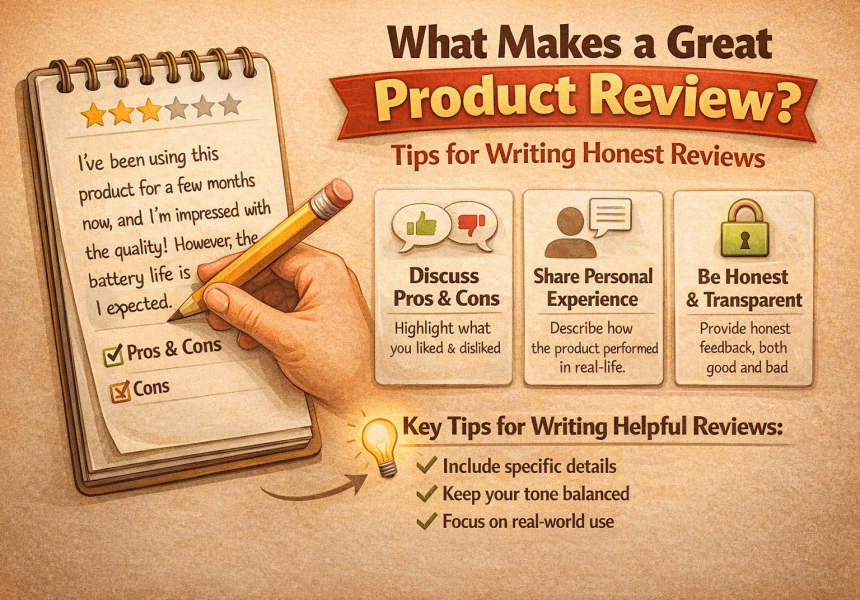
What Makes a Great Product Review? Tips for Writing Honest Reviews
Product reviews have become an essential part of the online shopping experience. They help other customers make informed decisions and provide valuable insights into the quality and performance of products. However, not all reviews are equally helpful. Some are vague, overly positive, or negative without justification.
Writing an honest, detailed product review can significantly help future buyers. In this article, we’ll explore tips for writing honest reviews, the key elements of a great review, and how to make your feedback truly useful to others.
How to Write a Great Product Review: Key Elements to Include
When you’re writing a review, it’s essential to include the right balance of information. Here are some product review writing tips to help make your review both honest and helpful:
a) Discuss the Pros and Cons
A good product review should highlight both the positive and negative aspects. Balanced feedback is crucial as it helps future buyers weigh the product’s strengths and weaknesses. Avoid overly glowing praise or harsh criticism without explanation. Instead, be specific about what you liked and disliked about the product.
Key Tip: Be detailed. For example, "I loved the speed and ease of use, but the battery life was shorter than expected, requiring daily charging."
b) Share Your Personal Experience
A great product review is rooted in your actual experience with the product. Avoid vague comments like "It’s great" or "It’s terrible." Instead, describe your experience. Did the product meet your expectations? How did it perform in real-world conditions?
Key Tip: Include specific details, such as how long you’ve used the product, the conditions you’ve used it in, and any issues you encountered. For example, “I’ve been using this blender for three weeks and have made smoothies almost every day. The motor is powerful, but it tends to overheat after extended use.”
c) Be Transparent
Honesty is vital. Don’t exaggerate the product's features or hide any shortcomings. Transparency builds trust with readers. If you received a product for free, mention that in your review to maintain transparency. Similarly, if a product doesn’t work as advertised, explain why.
Key Tip: If a product failed to meet your expectations, be clear about why. For instance, “Although the camera is advertised as having a 20MP resolution, I found the photos to be grainy in low light.”
Tips for Writing Honest Reviews: Striking a Balance
While it’s important to share both the pros and cons, balanced feedback is key to writing an honest review that is constructive and useful. Here are a few more tips for writing honest reviews:
Focus on your experience, not speculation: Stick to what you know. Avoid speculating about features you haven’t used or comparing products you haven’t tried.
Keep your tone respectful: Even if you had a negative experience, avoid using aggressive language. Aim for a tone that is clear, respectful, and objective.
Be mindful of exaggeration: Avoid statements like “This is the worst product ever!” or “I can’t live without this!” Instead, explain what could be improved or what worked well in practical terms.
Example of Balanced Feedback:
“The product is easy to use, and the design is sleek. However, the color options are limited, which is a disappointment if you’re looking for variety. It’s perfect for everyday use, but the stitching on the side of mine began to fray after a month of wear. The customer service team responded quickly and offered a replacement, which I appreciated.”
This review highlights both positive experiences (easy to use, sleek design) and specific issues (limited colors, stitching problem) in a neutral tone.
Examples of Well-Written Reviews to Serve as a Guide
Examples can help guide you in writing your own honest product review. Below are a couple of examples to help you craft reviews that are both informative and helpful.
Example 1: Positive Review
“I’ve been using this yoga mat for a few months now, and I love it! The material is comfortable and non-slip, which helps with stability during my practice. The thickness is just right for my knees, and I really appreciate the durability of the material. The only downside is that it’s a bit heavy to carry around, but that’s a minor issue. Overall, it’s been great for my daily routine!”
This review is detailed, positive, and shares both pros (comfort, stability, durability) and cons (heaviness). It also mentions the user’s experience over a few months.
Example 2: Constructive Negative Review
“I was excited to try this smartwatch, and while the design is sleek and the display is crisp, I was disappointed by the battery life. It only lasted about 12 hours on a single charge, which is less than what was promised. I’ve tried adjusting settings, but nothing seems to improve it. The fitness tracking is accurate, but the battery issue is a dealbreaker for me. I hope the company addresses this in future updates.”
This review is balanced, highlighting the positive features (design, display, tracking) and focusing on a single, significant issue (battery life). It also suggests potential for improvement.
How to Make Your Review Helpful for Other Customers
When writing a product review, remember that your goal is to help others make informed decisions. Here are some ways to ensure your review is valuable:
a) Be Specific
General comments are less helpful than specific details. For instance, instead of saying “This chair is uncomfortable,” explain why it’s uncomfortable, perhaps the backrest doesn’t provide enough support, or the material is too stiff.
Tip: Always try to include examples. “I find that after 30 minutes of sitting, my back starts to hurt because the chair doesn’t have lumbar support.”
b) Provide Context
Add context that might be helpful for other users. For example, if you’re reviewing a kitchen appliance, mention the size of your family, how often you use it, or whether it fits well in your kitchen.
c) Keep It Helpful and Detailed
It’s not enough to simply say "I love it" or "I hate it." Provide useful details like how the product fits into your life, what makes it stand out, or how it could be improved.
Conclusion: Write Honest and Balanced Product Reviews
Writing honest reviews doesn’t just mean sharing your opinion, it’s about providing useful feedback that can help others make informed choices. By focusing on pros and cons, sharing personal experiences, and maintaining transparency, your review can serve as a valuable resource for others.
Remember, a well-written review offers a balanced perspective that goes beyond just the features, it’s about how the product works in real life. Next time you write a review, keep these tips for writing honest reviews in mind. Your thoughtful feedback can be the difference between a buyer choosing a product, or walking away from it.